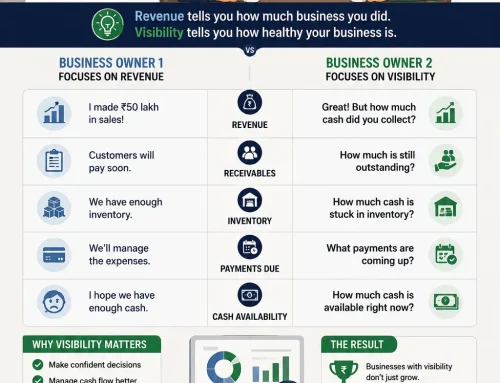

Founder finance visibility
Startups do not only need growth. They need to see what growth is doing to cash.
Early founders often know every customer, payment, and expense by memory. But as transactions grow, financial visibility needs to move from instinct to reliable reports, clean accounting data, and repeatable systems.
Quick Answer: Why Do Startups Need Financial Visibility?
Startups need financial visibility because growth increases transactions, expenses, receivables, hiring decisions, and cash pressure faster than founders can track manually. Without clear financial reports, founders may see revenue growing while cash flow, profitability, collections, or spending control quietly weakens.
Financial visibility helps founders answer the questions that matter: how much cash is available, who owes money, what costs are rising, whether the next hire is affordable, and whether growth is actually profitable.
One of the biggest mistakes startups make is assuming they will build systems later. In the early stage, everything feels manageable because the founder has direct visibility into almost every part of the business.
They know the customers. They remember the payments. They approve the expenses. They understand the daily decisions.
That founder-led visibility can work for a while. But as the startup grows, memory is no longer a system. The business needs financial visibility that does not depend on one person holding the picture in their head.
The Hidden Cost of Startup Growth
Growth creates more customers, more invoices, more payments, more vendors, more employees, and more expenses. The questions that were once easy suddenly require proper reporting.
| Founder question | Why it matters | Visibility needed |
|---|---|---|
| How much cash is available? | Revenue does not equal usable cash. | Cash flow and bank position reporting. |
| Who has not paid yet? | Delayed collections can hurt payroll, vendor payments, and growth plans. | Receivables ageing and follow-up visibility. |
| Can we afford the next hire? | Hiring adds recurring cost before the return is visible. | Runway, monthly burn, and expense trend reports. |
| Are we profitable by product, customer, or branch? | Top-line growth can hide weak margins. | Custom profitability and cost-center reporting. |
| Which expenses are rising fastest? | Small cost leaks become serious as the business scales. | Expense category and variance reports. |
The Financial Metrics New Founders Should Track Early
Founders do not need dozens of reports from day one. They need the right few numbers, reviewed consistently.
Are startup decisions still being made from scattered spreadsheets?
Review whether TallyPrime reports, custom MIS, cash flow views, and receivables dashboards can give founders cleaner visibility before growth becomes harder to control.
Why Spreadsheet-Only Visibility Breaks as Startups Scale
Spreadsheets are useful. The problem starts when they become the only way founders understand finance. As the business grows, data often spreads across accounting records, bank statements, emails, payment apps, CRM tools, inventory sheets, and manually updated dashboards.
When financial data is scattered, decision-making becomes slower and riskier:
- Cash position is checked manually instead of reviewed regularly.
- Outstanding payments are remembered informally.
- Expenses are reviewed after they have already grown.
- Profitability is estimated instead of measured.
- Founders delay decisions because the numbers are not ready.
Founder rule: If a number is important enough to affect hiring, pricing, credit, fundraising, or purchase decisions, it should not live only in someone’s memory or a loosely maintained spreadsheet.
Building Financial Systems That Support Startup Scaling
The startups that scale well are not always the fastest-growing. They are the ones that build clarity alongside growth. Financial visibility improves when accounting data, reporting, and operating systems are connected to the founder’s real decision needs.
| System area | What it should support | How TallyPrime can help |
|---|---|---|
| Accounting structure | Clean ledgers, groups, cost centers, and transaction categories. | Better report accuracy and easier review. |
| Cash flow tracking | Bank, cash, receivables, payables, and recurring expenses. | Cash position and payment planning. |
| Custom MIS | Founder-ready views of sales, margin, dues, expenses, and exceptions. | Faster decisions without manual report preparation. |
| Automation and integration | Data from CRM, billing, POS, website, or payment tools. | Reduced duplicate entry and more current numbers. |
| Access and continuity | Owners, finance teams, and advisors can review data when needed. | Cloud, user controls, and safer data access planning. |
Founder Decisions That Improve With Better Financial Visibility
Financial visibility is not only for accounting. It directly affects founder decisions.
- Hiring: Can the business carry the salary if collections are delayed?
- Pricing: Are margins healthy after delivery, discounts, and operating costs?
- Credit control: Which customers are slowing cash flow?
- Purchases: Is stock buying aligned with sales and cash availability?
- Fundraising: Are financial reports clean enough for investor or lender review?
- Expansion: Is growth increasing profit, or only increasing complexity?
Planning to scale but not confident in your finance reports?
Set up TallyPrime reporting, custom dashboards, access, and data structure early so founders can review cash, dues, expenses, and profitability without waiting for manual preparation.
Financial Visibility Checklist for Startup Founders
- Cash position: Can you see current cash and bank balances quickly?
- Receivables: Do you know which customers owe money and how old the dues are?
- Monthly burn: Do you know your recurring monthly expense base?
- Profitability: Can you see whether sales are profitable after direct and operating costs?
- Expense control: Can you identify fast-rising expense categories?
- Reporting rhythm: Are key numbers reviewed weekly or monthly without manual chaos?
- Data ownership: Is there one clean accounting source instead of multiple spreadsheet versions?
- Decision access: Can founders, finance teams, and advisors access the right reports when needed?
Related Guides and Services
CustomizationTallyPrime customization servicesAdapt TallyPrime around startup workflows, fields, reports, and controls.
VisibilityYour business is talking every dayUnderstand why current reports matter for faster business decisions.
ScalingBefore hiring more peopleSee why systems and visibility often matter before adding headcount.
Want founder-ready financial visibility inside TallyPrime?
Share your current accounting setup, reports, cash flow tracking, receivables process, and growth plans. We can help you decide what reports and systems should be built first.
Final Thoughts
Every founder eventually faces one important question: is the business growing, or is complexity growing faster than the business?
The answer often depends on how early the company builds visibility, reporting, and scalable financial systems. Startups that build clarity from the beginning are better positioned to manage risk, seize opportunities, and grow without losing control of the numbers.
Startup Financial Visibility FAQs
What is financial visibility for startups?
Financial visibility means founders can clearly see cash, receivables, expenses, profitability, dues, and key reports without relying on guesswork or scattered spreadsheets.
Why do new founders need financial visibility early?
Early visibility helps founders make better hiring, pricing, credit, purchase, fundraising, and expansion decisions before growth creates more complexity.
Which financial reports should startups track?
Startups should track cash flow, receivables ageing, monthly expenses, profitability, payables, sales trends, bank position, and exception reports.
Can TallyPrime help startup founders with reporting?
Yes. TallyPrime can support accounting, cash flow review, receivables, expense tracking, profitability reports, and custom MIS when structured properly.
When should a startup customize reports in Tally?
Custom reports are useful when founders need recurring views that default reports or manually prepared Excel sheets do not provide clearly enough.
How does financial visibility support scaling?
It helps founders manage cash, control expenses, monitor collections, understand margins, and make growth decisions with current data instead of delayed reports.