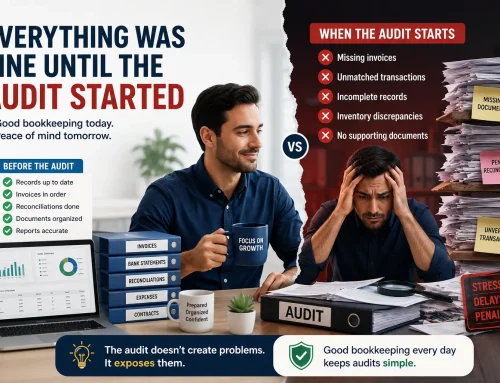

CA document and compliance process
Your CA is not asking again because they forgot. The process probably did.
Repeated document requests usually happen when invoices, receipts, GST details, bank records, and reconciliations are scattered across WhatsApp, email, folders, spreadsheets, and memory.
Quick Answer: Why Does My CA Keep Asking for the Same Documents?
Your CA usually keeps asking for the same documents because the records needed for GST filing, audit, tax returns, reconciliations, and financial statements are scattered, incomplete, unverified, or difficult to locate when needed. The repeated request is often not the real problem. The real problem is the missing document process behind the business.
When bookkeeping, document storage, Tally records, and reconciliations are maintained consistently, CA follow-ups reduce because the information becomes easier to verify.
If you have ever run a business, you have probably had this conversation.
CA: “Can you send me the purchase invoice?”
You: “I already sent it.”
CA: “No, that is the sales invoice.”
Three hours later, the invoice has become less of a document and more of a treasure hunt.
Sound familiar? You are not alone. One of the most common complaints business owners have is: “Why does my CA keep asking for the same documents?” The funny part is that many CAs are wondering the opposite: “Why do I have to keep asking for the same documents?”
The Great Document Mystery in Growing Businesses
Almost every business has a system. But sometimes that “system” is really a scattered trail.
- Invoices are in WhatsApp chats.
- Receipts are in email attachments.
- Purchase bills are in a folder created years ago.
- Bank statements are downloaded but never renamed.
- Some documents exist only as photos on someone’s phone.
Everything feels manageable until someone actually needs the records. That is when the chaos begins.
The Problem Is Usually Not the CA
Your CA is not asking for documents because reminders are fun. They are asking because those documents support the numbers in your books.
Every GST filing, audit, tax return, reconciliation, and financial statement depends on records that can be verified. Without documents, numbers become assumptions. And assumptions do not survive audits, tax reviews, or serious financial decisions very well.
Simple truth: The CA is not asking for “paperwork.” They are asking for evidence behind the numbers.
Which Documents Keep Getting Requested and Why?
| Document type | Why your CA needs it | Common reason it gets requested again |
|---|---|---|
| Purchase invoices | Input tax credit, expense booking, vendor reconciliation, and audit support. | Invoice is missing, unclear, duplicated, or not matched with Tally entry. |
| Sales invoices | GST output, revenue recognition, customer balance, and return filing. | Invoice number, GST details, or party mapping does not match records. |
| Bank statements | Bank reconciliation, receipts, payments, loan entries, and cash flow review. | Statement period is incomplete or not reconciled regularly. |
| Expense receipts | Expense verification, tax treatment, audit proof, and reimbursement support. | Receipt exists in email or phone but is not linked to accounting entry. |
| GST records | Filing, reconciliation, notices, input credit review, and compliance checks. | Books, portal data, and invoices do not match cleanly. |
| Customer and vendor confirmations | Balance verification, audit, receivables, payables, and dispute resolution. | Outstanding balances are not updated or confirmed on time. |
Still searching for invoices every time your CA asks?
Review whether your Tally records, document storage, GST data, and reconciliations can be organized so compliance work becomes routine instead of a last-minute chase.
Why the Same Documents Keep Coming Up
There are usually three reasons the same documents keep returning to the conversation.
The Hidden Cost of Missing Documents
Missing paperwork feels like a small inconvenience until you count the cost.
| Problem | Visible inconvenience | Real business cost |
|---|---|---|
| Invoice not found | Someone searches WhatsApp, email, folders, or phones. | Filing delay, missed ITC risk, or incorrect expense support. |
| Bank entries not reconciled | CA asks for statement again. | Cash visibility and financial statements become less reliable. |
| GST records mismatch | More follow-up before filing. | Potential compliance errors, notices, or credit issues. |
| Audit support missing | Old documents are hunted during deadline pressure. | Stress, time loss, and avoidable professional follow-up. |
What Organized Businesses Do Differently
The businesses that rarely get chased by their CA are not necessarily the largest. They are usually the most organized.
- They maintain clean bookkeeping: Entries are recorded correctly and reviewed regularly.
- They store documents consistently: Invoices, receipts, statements, and confirmations are named and saved properly.
- They reconcile frequently: Bank, GST, receivables, payables, and vendor records are checked before deadlines.
- They use one approved source: Teams know where the latest records live.
- They build repeatable processes: Document handling does not depend on memory or one person.
Want fewer follow-up emails during GST, audit, and return filing?
Build a better record process around TallyPrime so invoices, bank entries, GST data, and reconciliations are easier to verify when your CA needs them.
How TallyPrime Can Help Reduce Document Confusion
TallyPrime alone does not magically organize every document. But when accounting structure, custom fields, reports, user controls, and reconciliation habits are planned well, it becomes easier to connect entries with the records behind them.
- Cleaner ledger and voucher organization helps locate transactions faster.
- Custom fields can capture references needed by the business or CA.
- Custom reports can highlight missing details, outstanding balances, or exception entries.
- Better access and process design reduces dependency on one person.
- Regular review reports help teams prepare before deadlines arrive.
Related Guides and Services
ReportsTallyPrime report customizationCreate reports that help identify missing details, reconciliation gaps, and exception records.
VisibilityYour business is talking every dayImprove business visibility with reports that surface the right issues sooner.
Cash FlowA conversation between two business ownersUnderstand why visibility matters beyond revenue numbers.
Want a smoother CA document and reconciliation process?
Share how your team stores invoices, receipts, GST records, bank statements, and Tally entries today. We can help identify the process gaps causing repeated document requests.
Final Thoughts
Every business owner wants fewer follow-up emails from their CA. Every CA wants fewer reminders to business owners. The solution is not better memory. It is better process.
When documents are organized, records are updated, and bookkeeping is maintained properly, repeated requests start disappearing. The relationship with your CA becomes less about finding paperwork and more about improving the business.
CA Document Request FAQs
Why does my CA ask for the same documents repeatedly?
Repeated requests usually happen because documents are scattered, incomplete, not reconciled, or needed for multiple compliance and reporting purposes.
Which documents do CAs commonly ask for?
CAs commonly ask for purchase invoices, sales invoices, bank statements, expense receipts, GST records, customer confirmations, vendor confirmations, and reconciliation details.
Is the CA asking again because they lost the document?
Sometimes documents are misplaced, but often the issue is that the document was incomplete, unclear, mismatched, or needed again for a different compliance purpose.
How can businesses reduce repeated CA follow-ups?
Maintain clean bookkeeping, organize documents consistently, reconcile regularly, use one approved storage process, and review missing records before deadlines.
Can TallyPrime reduce document confusion?
Yes, when TallyPrime records, ledgers, voucher references, custom fields, reports, and reconciliation processes are maintained properly.
What is the real cost of missing documents?
Missing documents can cause filing delays, audit stress, reconciliation errors, missed ITC risks, poor visibility, and unnecessary time spent searching for records.