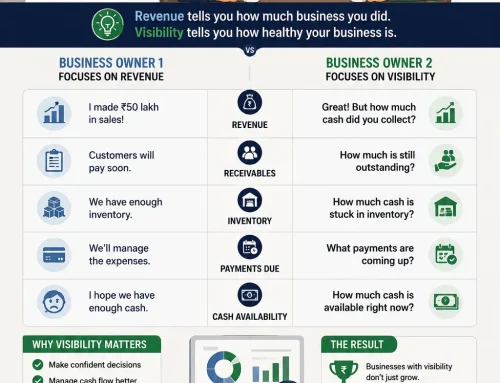

Manual work vs connected systems
He did not need “software.” He needed to stop losing 20 hours a week.
Tally for business management is not only about accounting entries. For a growing business, it can connect invoicing, inventory, payments, GST, reporting, and owner visibility into one working system.
Quick Answer: Why Does a Business Need Tally if Things Are Already Working?
A business may need Tally even when daily work appears fine because manual invoicing, payment tracking, inventory updates, GST reconciliation, and report preparation often hide a large cost in time, errors, and delayed visibility.
TallyPrime helps when the business needs one connected place for accounting, inventory, taxation, reporting, and operational control.
A few months ago, we met a business owner who was absolutely convinced he did not need accounting software.
His exact words were: “Why would I spend money on software? My business is running fine.”
From his perspective, everything was working. Invoices were being created, payments were coming in, GST was being filed, and customers were happy. So naturally, his question was simple: “What is the problem?”
Everything Worked. But Nothing Was Connected.
The business was not using one system. It was using five. Invoices were created in one place, payment records were tracked somewhere else, inventory was maintained separately, GST information was stored in another file, and reports were prepared manually whenever required.
Nobody thought this was unusual because that was how they had always worked. But every day, the team spent hours moving information from one place to another because they had no other option.
| Business task | How it was handled | What it quietly created |
|---|---|---|
| Invoice creation | Prepared separately from payment and stock records | Duplicate work and delayed updates |
| Payment tracking | Maintained outside the main accounting workflow | Missed follow-ups and unclear receivables |
| Inventory updates | Managed separately from billing | Stock mismatch and manual correction |
| GST reconciliation | Prepared from scattered records | Extra checking and higher error risk |
| Reports | Created manually whenever needed | Delayed visibility for the owner |
The Real Cost Was Not the Software
We asked one simple question: “How much time does your team spend every week just updating records?”
The room went silent because nobody had calculated it. When we added invoice creation, payment tracking, stock updates, report preparation, GST reconciliation, and error correction, the team was spending close to 20 hours every week on low-value administrative work.
How much time is your team losing to manual updates?
If invoicing, stock, payments, GST, and reports live in separate places, review whether TallyPrime customization or better setup can reduce repeated work.
Most business owners look at software and see an expense. What they often do not see is the hidden cost of not using the right system: delayed reports, duplicate work, manual mistakes, missed follow-ups, lack of visibility, and time that the business cannot buy back.
So We Showed Him Tally as a Business Management Tool
We did not show TallyPrime only as accounting software. We showed it as a way to bring important business information into one working system.
| Before | With TallyPrime | Business impact |
|---|---|---|
| Invoices prepared manually | Invoices can be generated faster from structured data | Less billing delay |
| Inventory updated separately | Stock can move with transactions | Cleaner inventory visibility |
| GST data checked manually | GST-related values and reports can be structured better | Less reconciliation pressure |
| Reports prepared from scratch | Reports can be accessed more quickly | Faster owner decisions |
| Information scattered across files | Key data can live in one system | Better operational control |
The Change Was Not Immediate, But It Was Clear
Like most business owners, he was skeptical. He had built his business through hard work and trusted the systems he already knew.
But after a few weeks of using Tally, the team stopped chasing information and started using it. Instead of spending hours preparing reports, they spent time understanding what the reports were saying. Instead of fixing repeated errors, they focused on improving operations.
Six months later: He was no longer talking about software. He was talking about growth, better visibility, faster decisions, improved productivity, and a team that finally had time to focus on meaningful work.
What Growing Businesses Should Learn From This
- If reports are prepared manually every time, visibility is delayed.
- If the same data is entered in multiple places, errors are almost certain.
- If inventory, payments, GST, and invoices are separate, the owner sees the business late.
- If the team spends hours updating records, the business is paying for hidden administration.
- The right Tally setup can reduce manual work without changing the trusted accounting platform.
Still asking, “Do we really need software?”
Start by calculating the weekly cost of manual invoicing, payment tracking, stock updates, GST reconciliation, and report preparation. That number usually answers the question.
Related Guides and Services
Guide10 signs your business needs Tally customizationKnow when repeated manual work points to a system issue, not a staffing issue.
GrowthWhat growing businesses need before hiring more peopleUnderstand why process clarity often comes before adding headcount.
B2BWhy B2B businesses need more than accounting softwareSee how operational visibility affects sales, collections, purchase, and stock decisions.
Final Thoughts
Most businesses do not realise they are carrying operational baggage until they put it down. Software is not about replacing people. It is about helping people work smarter.
The question often changes from “Why do I need Tally?” to “How did we manage without it for so long?”
Tally for Business Management FAQs
Is Tally only accounting software?
No. TallyPrime is widely used for accounting, but it can also support invoicing, inventory, GST, reporting, user controls, and business management workflows.
When does a business need Tally?
A business should consider Tally when manual records, scattered files, delayed reports, GST work, inventory updates, or payment tracking start consuming too much time.
Can Tally reduce manual work?
Yes. With the right setup and customization, Tally can reduce repeated entry, improve report access, structure GST data, and connect related business information.
What is the hidden cost of not using software?
The hidden cost includes time spent updating records, correcting errors, preparing reports manually, missing follow-ups, and making decisions with delayed information.
Can Tally be customized for business-specific workflows?
Yes. TallyPrime can be customized for invoices, reports, approvals, inventory logic, integrations, and industry-specific processes.
Should a small business use Tally?
Small businesses can benefit from Tally when they need organized accounting, GST readiness, inventory visibility, invoice control, and reports that are easier to trust.