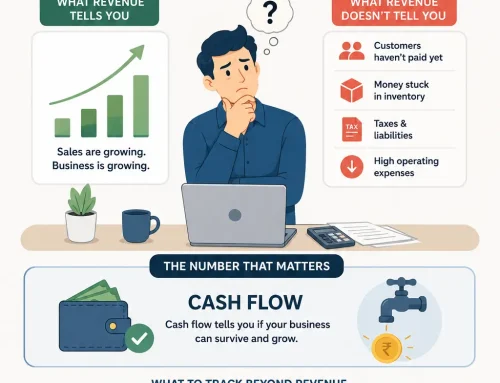

Sales growth cash flow problem
Growing sales do not fill the bank account until the cash actually arrives.
Orders, invoices, and revenue can all rise while cash stays tight because customers have not paid, stock has absorbed working capital, expenses have grown, and upcoming liabilities are not visible early enough.
Quick Answer: Why Are Sales Growing but the Bank Account Still Empty?
Sales can grow while the bank account stays empty because revenue is not the same as collected cash. Money may be stuck in unpaid invoices, excess inventory, GST and compliance dues, vendor payments, salaries, rent, operating expenses, and working capital needs.
The business may not have a revenue problem. It may have a cash flow visibility and collection timing problem.
One of the most common conversations with business owners sounds like this: “We are doing more sales than ever before, but somehow there never seems to be enough cash in the bank.”
It is a fair question. Orders are coming in, revenue is increasing, customers are buying, and on paper everything looks great. So why does it still feel like the business is constantly chasing cash?
The answer is simple: sales and cash are not the same thing.
The Illusion of Growth
Most business owners look at revenue as the main measure of success. Revenue matters, but it does not tell the complete story.
Suppose your business generates Rs. 10 lakh in sales this month. It sounds fantastic. But what if a large part of that number has not reached the bank yet?
Where the Sales Number Goes Before It Becomes Cash
| Rs. 10 lakh sales month | What may be happening | Cash flow impact |
|---|---|---|
| Rs. 5 lakh still receivable | Customers have been billed but have not paid yet. | Sales exist, but usable cash is delayed. |
| Rs. 2 lakh in inventory | Stock was purchased to support demand. | Working capital is sitting on shelves. |
| Rs. 1 lakh for GST and compliance | Statutory payments are due soon. | Cash must be reserved, not treated as free surplus. |
| Rs. 2 lakh in salaries, rent, and expenses | Operating costs continue regardless of collection timing. | Monthly commitments consume available balance. |
The sales happened. The cash did not arrive in the same shape or at the same speed.
The Biggest Mistake: Treating an Invoice Like Money
Many businesses celebrate the moment an invoice is raised. But an invoice is not money. It is a promise of money.
Until payment actually reaches the bank account, the business cannot use that invoice to pay suppliers, salaries, GST, rent, or other expenses. This is why businesses can have outstanding receivables worth lakhs and still struggle with daily cash pressure.
Do you know exactly how much sales money is still outside the bank?
Review whether your Tally reports show receivables ageing, overdue customers, expected collections, upcoming payments, and cash availability in one owner-ready view.
Why Growth Can Create Cash Flow Problems
Growing businesses often experience more cash flow pressure than stable businesses because growth usually demands more spending before all the cash comes in.
- More inventory is purchased to fulfil more orders.
- More employees are hired to handle more work.
- More logistics, rent, subscriptions, and operating costs appear.
- More GST, vendor, and working capital requirements build up.
If cash inflows do not keep up with these demands, the business feels stretched even while sales continue to rise.
Where Is the Money Actually Going?
Profit Does Not Equal Cash
A company can be profitable and still struggle with cash flow. Profit is calculated based on accounting records. Cash flow is based on actual money entering and leaving the business.
You might record a profitable sale today, but if the customer pays after 60 days, profit appears immediately while cash arrives much later. That gap is where many businesses run into trouble.
| Business number | What it shows | What owners must still check |
|---|---|---|
| Sales | How much business was booked. | How much has been collected. |
| Profit | Whether revenue exceeds costs on paper. | Whether enough cash is available today. |
| Bank balance | What is currently available. | What dues are coming up soon. |
| Cash flow | How money moves in and out over time. | Whether growth is financially sustainable. |
Want sales growth to show the cash picture, not only revenue?
Build custom TallyPrime reports for receivables, inventory value, payables, GST dues, expense trends, and monthly cash flow.
The Reports Every Business Owner Should Review
- Current bank balance: What cash is available right now.
- Receivables ageing: Which invoices are unpaid and how long they have been pending.
- Payables and upcoming liabilities: What suppliers, GST, salaries, rent, and loans need payment.
- Inventory value: How much cash is blocked in stock, especially slow-moving stock.
- Operating expense trend: Which expenses are growing quietly as the business scales.
- Monthly cash flow: Whether cash coming in is enough for cash going out.
Why Financial Visibility Matters
Most cash flow problems do not appear overnight. They build slowly: a few delayed payments, extra inventory, some rising expenses, and a few upcoming liabilities. Individually, they may not look serious. Together, they create pressure.
The businesses that stay ahead are usually the ones that see these numbers before they become emergencies.
Related Guides and Services
Cash FlowA conversation between two business ownersSee why collected money matters more than booked revenue.
ReportsTallyPrime report customizationCreate owner-ready cash flow, receivables, inventory, and liability reports.
VisibilityFinancial visibility for foundersBuild reporting habits before growth creates blind spots.
Want to know why sales are growing but cash still feels tight?
Share your sales, receivables, inventory, expenses, GST dues, and current reporting process. We can help identify the reports that reveal where the money is stuck.
Final Thoughts
If sales are growing but your bank account still feels empty, do not assume the business is failing. In many cases, the issue is not lack of revenue. It is lack of visibility.
Understanding where money is tied up, how quickly payments are collected, and how cash moves through the business can completely change the way you manage growth. Businesses do not run on revenue. They run on cash.
Sales Growth Cash Flow FAQs
Why is my bank account empty even though sales are growing?
Sales may be growing while cash is stuck in unpaid invoices, inventory, GST dues, vendor payments, salaries, rent, expenses, or working capital needs.
Is an invoice the same as cash?
No. An invoice is a claim or promise of payment. It becomes usable cash only when the customer pays and money reaches the bank.
Can a profitable business still have cash flow problems?
Yes. Profit can appear before cash arrives, especially when customers pay late or money is blocked in stock and receivables.
What reports should I check when cash feels tight?
Check bank balance, receivables ageing, payables, inventory value, GST liabilities, expense trends, and monthly cash flow.
Why does growth create cash pressure?
Growth often requires more stock, people, expenses, credit, and working capital before collections catch up.
Can TallyPrime help improve cash flow visibility?
Yes. With proper structure and custom reports, TallyPrime can show receivables, inventory, payables, liabilities, expenses, and cash flow more clearly.